Yesterday I was still bored
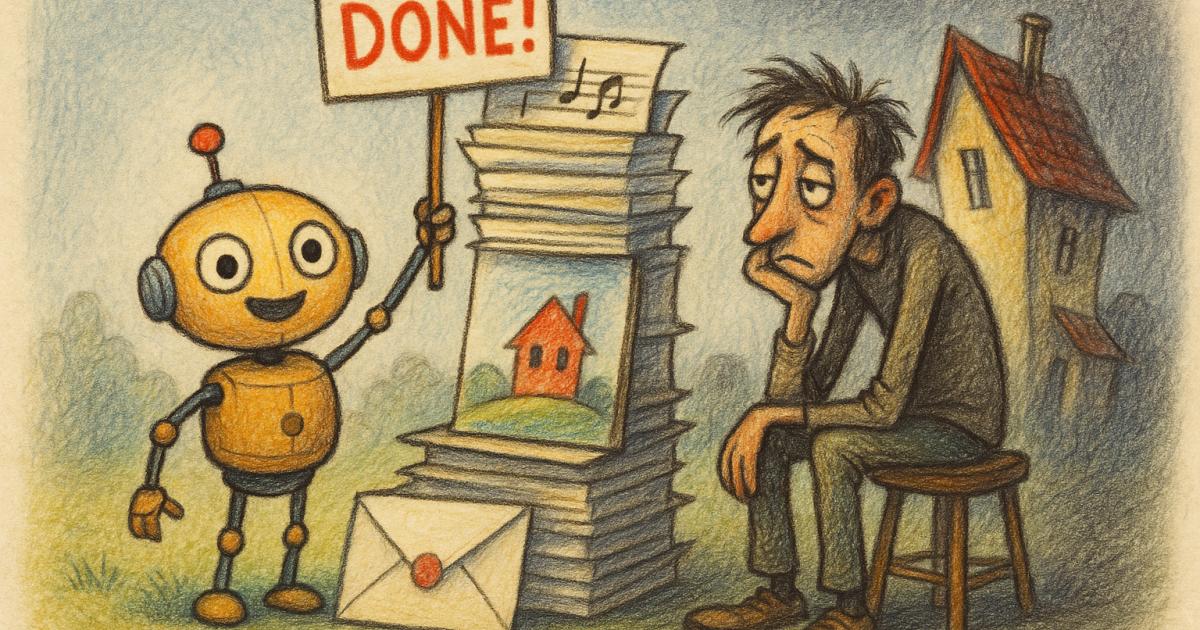
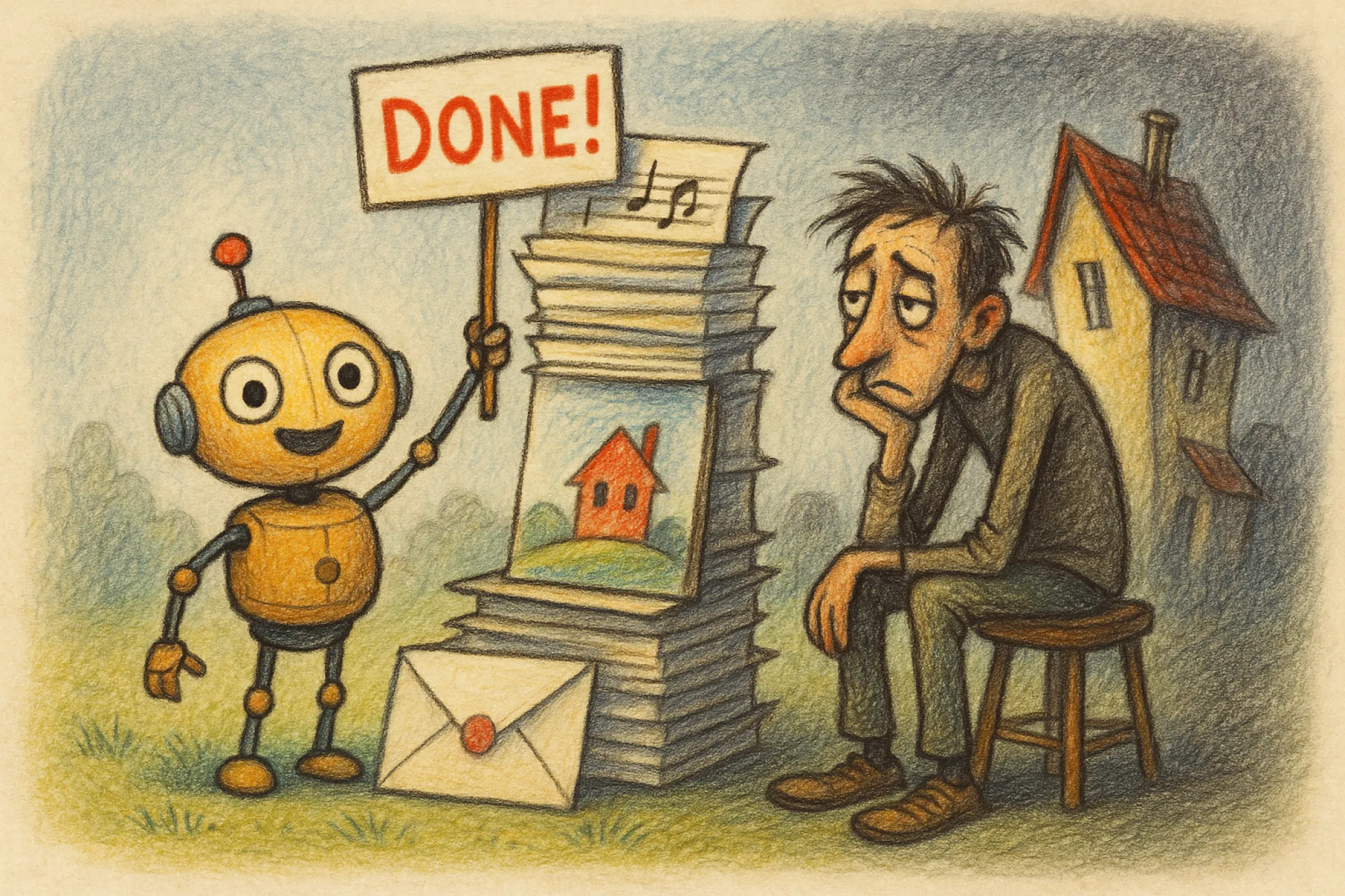
Yesterday I sat down to clear my inbox and caught myself thinking, “ah, I've got to enter a prompt now.” One prompt, which would answer ten of my emails in seconds. A few months ago that thought was “oh, I've got to answer emails now.” The job has shrunk to almost nothing, and I still sighed at it.
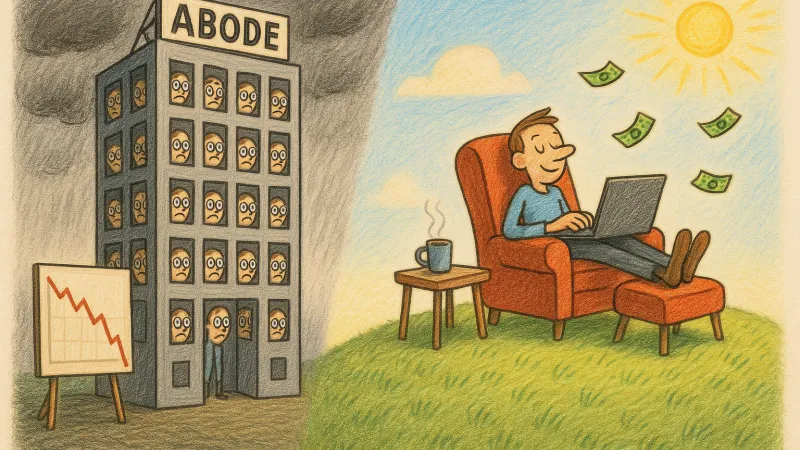
Everyone seems to be talking loudly about the AI bubble bursting. It might not be, but the desire definitely is.
Ray Dalio says the bubble could soon burst, a strategist has warned of the worst S&P 500 crash since 2008, and the IMF thinks a correction could ripple through markets, though it isn't predicting an imminent collapse. Dalio's worry is debt and interest rates, though, not whether anyone finds the tools useful. The money and the tools are two different stories, and I'm more interested in the second.
A year ago everyone was making AI music, AI pictures, AI this, that and everything, because it was a novelty. That seems to be slowing down, and I think I know why.
Before AI, if you wanted to write music, nothing was stopping you writing music. It just took longer. Nothing was stopping you being an artist. It just took longer. Nothing was stopping you writing software. It just took longer.
AI has reduced that barrier, but not necessarily the desire. So people used it to make pictures, write songs, write programs and answer their emails, and it didn't make any of those things more enjoyable. It didn't make anyone want to do them much more. Plenty of people tried it, got bored and went back to what they were doing before.
My own workflow has become something like ten times easier because AI agents do a lot of the boring stuff for me. But easier hasn't meant more exciting. I'm still like, ah, I've got to do the thing, even though it only takes seconds now.
What the numbers say
I wanted to back that up, and the data mostly does. Growth in AI app downloads went from 71% to 26% to 7% over the last three half-years. AI apps lose their paying subscribers about 30% faster than other apps, and a lot of people only downloaded them because a trending video showed off one trick. Midjourney's traffic has gone flat. And OpenAI shut down its Sora app in April, six months after launch, once downloads had fallen off a cliff. Competition and copyright rules played a part there too, but it's hard not to see a novelty app running out of novelty.
To be honest with you, the numbers don't all point my way. The time people spend in AI apps is expected to more than double this year. Suno says it has “far beyond” two million subscribers. Weekly use of tools like ChatGPT nearly doubled in a six-country survey, from 18% to 34%.
But look at what people are using it for. In that same survey, using AI to look things up more than doubled, while making video with it stayed at 3% and audio at 2%. It's the boring stuff that's growing. And Suno? Over 20 million people have tried it and about 2.5 million actually use it, and its downloads peaked last year while the active users kept coming. The dabblers made a song and left. The people who already wanted to make music stayed.
Audiences can tell
This is the bit that matters if you make videos. In a July survey of more than 5,000 US adults, 36% said they're less likely to engage with something they know is AI-generated, and only 14% said they'd be more interested. Nearly half think AI has made content worse. One influencer agency's research has preference for AI-made creator content down from 60% to 26% in three years, while 87% of creators say they're using AI more than ever.
Creators are using it more behind the camera, and audiences are marking it down in front of it. Nobody watching your video knows or cares that AI answered your sponsor emails. They notice straight away when it's standing in for you.
Who pays for all this?
Which leaves the money, and a question I can't answer. If the desire is cooling, was the rush into AI really a bubble? Is there enough use left to pay for it?
The gap is huge. Goldman Sachs reckons about $800bn is going into AI infrastructure this year, and that the biggest cloud companies are roughly $230bn a year short of what they'd need to earn to break even. Only about 3% of US households pay for AI at all, usually around $20 a month. OpenAI is bringing in about $50bn a year and reportedly lost $12.3bn running the business in a single quarter.
I can see it going two ways. Either the big companies survive and have to earn it all back from the people who actually use it, and now that we've sifted out who really benefits, those people could be facing massively bigger bills: smaller free tiers, higher prices, paying per use. Or there's a crash and all that capacity gets cheap, the way the fibre laid during the dot-com boom ended up powering the next ten years of the web for next to nothing.
Nobody knows which. I'd plan for both.
Don't put all your eggs in one basket
What worries me more than the bills is this. If an AI company, or one of its products, can just vanish, that's a barrier in itself. Businesses want to build AI into what they do, but the thing they come to depend on might not be there next year. Sora users were told to export their stuff as soon as possible before it was deleted for good.
That leaves the door wide open for tools that don't depend on any one big player: open-weight models you can download and run yourself, so nobody can switch them off, and gateways that sit in front of lots of models and let you move if one gets expensive or disappears.
Full disclosure: I build one of these, so I'm hardly neutral. DevSpanner is a developer console whose assistant, GoLLeM, sits in front of models from different providers, including Claude, GPT, Gemini, Grok, DeepSeek and open-weight models, under one account, metered at each provider's list price. It's built on open-source tools and independent of the big providers. It also runs a peer-to-peer network, “the mesh”, of members' own machines, which run open-weight models overnight and earn compute credits. Early access is by invitation, through a waitlist at devspanner.com. You don't need mine to take the point, though.
So here's what I'd do. Give AI the boring jobs, the emails and the admin and the rough first drafts, and keep it off camera. If you do use it on screen, say so, before your audience works it out for themselves. Know what you'd switch to if a tool you rely on doubled its price or shut down tomorrow, and export your work now and then. Keep an eye on your bills too, because that's where you'll see which way the money goes first.
And if you still sigh at your inbox, you're not alone. AI made the job smaller. It didn't make it fun.
Sources
- Forbes: Dalio warns AI bubble could soon burst
- Bloomberg: strategist warns of worst S&P 500 crash since 2008
- Bloomberg via Yahoo Finance: Dalio on AI bubble
- The Register: IMF AI bubble warning
- Sensor Tower: State of AI 2026
- RevenueCat: AI app retention study
- Similarweb: midjourney.com
- OpenAI Help Center: Sora discontinuation
- ContentGrip: Sora downloads drop
- Digital Music News: Suno subscribers
- Reuters Institute: Generative AI and news report 2025
- Business of Apps: Suno statistics
- Menlo Ventures: 2026 state of consumer AI
- CX Today: Gartner on AI-generated content quality
- Billion Dollar Boy: The real impact of AI on the creator economy
- TechTimes: Goldman Sachs on AI's $230bn annual gap
- Moneywise: Bank of America data on AI subscribers
- Bloomberg: OpenAI expects $70bn annualized revenue
- Exploding Topics: OpenAI revenue